




















Regulatory And Political Risk
The telecommunications and digital industries are subject to regulatory and political shifts that can directly impact our business viability, competitive position, and long-term growth.
To manage these risks, we adopt a proactive approach guided by the Axiata Regulatory Compliance Framework. Beyond formulating Group-wide positions on key issues, we undertake joint on-ground engagements to advance strategic regulatory stances at the OpCo level. These efforts are supported by the Regulatory Expert Working Group, which facilitates the systematic sharing of best practices across our entities. We also remain active in consultations and industry association events, fostering collaboration to address common challenges and advocate for policies that enable sustained growth and innovation in the sector.

Our Approach to Stakeholder Engagement
We are committed to proactively engaging with regulators, policymakers and industry players to address compliance challenges and explore strategic opportunities.
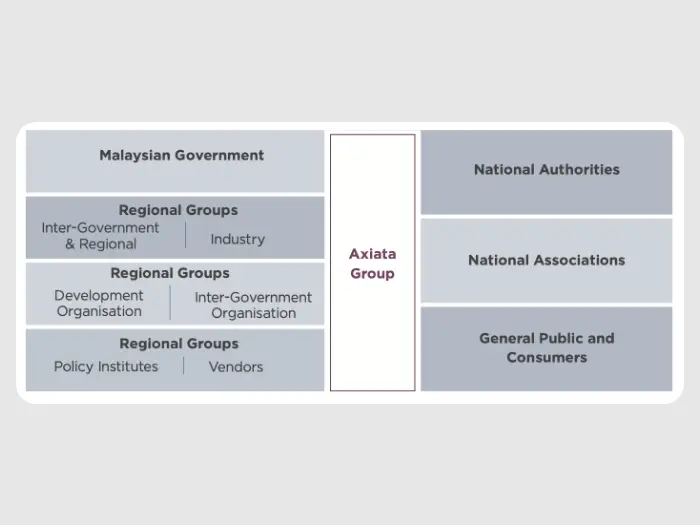
Stakeholder groups we engage with include:
-
National governments and regulatory authorities to align on industry policies
-
Regional and global industry associations to advocate for fair and sustainable regulatory frameworks
-
Business and development organisations to support infrastructure growth and digital inclusion
-
Vendors, public policy institutes and the general public to ensure transparent, responsible and consumer-focused operations
Navigating Regulatory And Political Risks In 2025
Axiata continued to navigate a challenging regulatory and geopolitical landscape across its markets. Political transition in Bangladesh, regional tensions in Cambodia, complex regulatory regimes in Indonesia, increased regulatory oversight in fintech and a growing focus on AI, digital governance, infrastructure dependencies, consumer protection requirements and technology risk regulations require disciplined oversight and agile responses. The Group prioritises regulatory stability, policy consistency and proactive stakeholder engagement to safeguard long term investments, operational continuity and sustainable growth.

Regulatory And Political Risk
The telecommunications and digital industries are subject to regulatory and political shifts that can directly impact our business viability, competitive position, and long-term growth.
To manage these risks, we adopt a proactive approach guided by the Axiata Regulatory Compliance Framework. Beyond formulating Group-wide positions on key issues, we undertake joint on-ground engagements to advance strategic regulatory stances at the OpCo level. These efforts are supported by the Regulatory Expert Working Group, which facilitates the systematic sharing of best practices across our entities. We also remain active in consultations and industry association events, fostering collaboration to address common challenges and advocate for policies that enable sustained growth and innovation in the sector.
Our Approach to Stakeholder Engagement
We are committed to proactively engaging with regulators, policymakers and industry players to address compliance challenges and explore strategic opportunities.
Stakeholder groups we engage with include:
-
National governments and regulatory authorities to align on industry policies
-
Regional and global industry associations to advocate for fair and sustainable regulatory frameworks
-
Business and development organisations to support infrastructure growth and digital inclusion
-
Vendors, public policy institutes and the general public to ensure transparent, responsible and consumer-focused operations
Navigating Regulatory And Political Risks In 2025
Axiata continued to navigate a challenging regulatory and geopolitical landscape across its markets. Political transition in Bangladesh, regional tensions in Cambodia, complex regulatory regimes in Indonesia, increased regulatory oversight in fintech and a growing focus on AI, digital governance, infrastructure dependencies, consumer protection requirements and technology risk regulations require disciplined oversight and agile responses. The Group prioritises regulatory stability, policy consistency and proactive stakeholder engagement to safeguard long term investments, operational continuity and sustainable growth.