



















Climate Change
We recognise the importance of taking committed, long-term climate action, not only in response to climate science and increasing escalating physical risks, but also as a catalyst for operational resilience, innovation and efficiency.
As part of our commitment to achieving net-zero emissions by 2050, we are currently updating our Net-Zero Carbon Roadmap with clearly defined near-term and net-zero targets based on a 2022 baseline. These targets include reducing absolute Scope 1 and Scope 2 greenhouse gas (GHG) emissions by 42% by 2030 and 90% by 2050, as well as reducing absolute Scope 3 emissions by 25% by 2030 and 90% by 2050.
In June 2024, these targets were approved by the Science Based Targets initiative (SBTi), making Axiata the first telecommunications company in Malaysia to receive such validation. This endorsement affirms that our decarbonisation pathway is grounded in climate science and aligned with internationally recognised best practices.
Our approach to climate action is further strengthened by our adoption of the Task Force on Climate-related Financial Disclosures (TCFD) recommendations, which strengthen our ability to assess climate-related risks and embed them into strategic decision-making.
Our pathway to net-zero
The Axiata Net-Zero Carbon Roadmap outlines three strategic objectives that chart our course towards achieving net-zero carbon emissions by no later than 2050.
The roadmap is currently undergoing an update and will be made available for download once this process is completed

Decarbonise network operations
Near-term target to reduce absolute Scope 1 and Scope 2 GHG emissions by 42% by 2030 from a 2022 baseline*
*Reduction targets set in accordance with SBTi guidelines

Transform our value chain
Long-term target to reduce absolute Scope 3 GHG emissions by 25% by 2030 from a 2022 baseline*
*Reduction targets set in accordance with SBTi guidelines

Deliver an inclusive climate agenda
Contribute to positive climate action through carbon removal and by enabling avoidance through technology and digitisation
Decarbonise network operations
The first objective of our Net-Zero Carbon Roadmap is about reducing emissions from our operations (Scope 1 and 2). Our approach centres on strengthening energy efficiency and identifying opportunities for the introduction of renewable energy sources. We also engage in dialogue with industry players, government authorities and communities, where we advocate for climate policies and investments that would help us reach our goals and achieve national climate ambitions.




Initiatives to decarbonise network operations
We continue to achieve progress in developing a strategic roadmap for reducing our Scope 1 and 2 emissions. Our focus areas include enhancing energy efficiency across network infrastructure, scaling on-site renewable energy generation, and actively evaluating Renewable Energy Certificate (REC) and Power Purchase Agreement (PPA) options in high-emission markets across our OpCos.
Our OpCos made the following progress in 2024:


Co-hosted the Axiata Sustainability & Reporting Suite Forum in Jakarta to align with net-zero and TCFD action plans, strengthen Sustainability Framework implementation, and standardise reporting
(XL Axiata is known as XLSMART since 16 April 2025)

Subscribed to Tenaga Nasional Berhad’s Green Electricity Tariff (GET) Programme for selected sites in Malaysia
We achieved an approximate 11% reduction in network fuel energy consumption and 29% reduction in facility electricity energy consumption in 2024, marking strong progress in a key pillar of our net-zero efforts.
Highlights of our OpCos’ performance included:

Implemented features saving, simplification, and fuel reduction measures at network sites, saving approximately 93 million kWh of electricity and 112 litres of fuel
(XL Axiata is known as XLSMART since 16 April 2025)

Implemented a range of measures including minimising diesel-powered genset dependency, implementing containment for cooling optimisation and upgrading rectifiers across sites
Implemented DC Energy Leasing and Remote Monitoring System (RMS) to optimise network energy consumption, improve energy efficiency and enable proactive maintenance

Converted 603 indoor base station sites to outdoor setups, while reducing energy consumption through network modernisation and legacy system shutdowns

Implemented iPowerStar 2.0 – an AI-powered solution – across the Smart network, while introducing Intelligent Digital Management Unit (iDMU) to dynamically manage network capacity by shutting down low-traffic cells

Upgraded Hybrid Fibre-Coaxial (HFC) home-passed areas to Fibre to the Home (FTTH), improving energy efficiency and network performance
As of end-2024, we have deployed over 7,178 solar sites across our operations to help mitigate the carbon-intensive energy mix in our markets. In parallel, our OpCos continue to phase out diesel generators by introducing lithium battery systems and hybrid charging solutions for remote Base Transceiver Stations (BTS), significantly reducing diesel consumption.
OpCo highlights in 2024 include:
Deployed solar panels, including four new Supernode Solar Panels situated in key locations, and purchased 1,000 RECs
(XL Axiata is known as XLSMART since 16 April 2025)

Implemented solar energy solutions at new and existing access sites, adding nearly 50 kW of solar capacity during the year

Deployed 150 new solar sites in 2024, bringing its total to 1,674 sites across Cambodia

Converted genset sites to solar hybrid sites, integrating solar PV panels with diesel generators to ensure reliable power for off-grid locations

Our Energy Consumption Performance
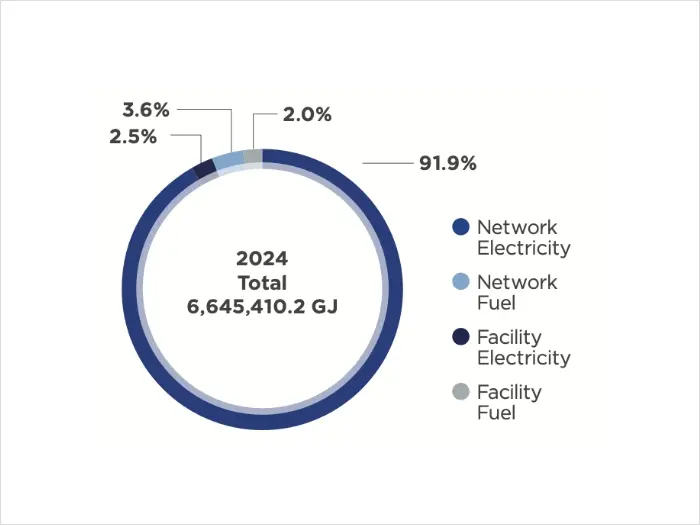
Group-wide energy consumption (excluding energy generated from renewables) increased by approximately 7% in 2024. Close to 92% of energy consumed across the operations during the year was used to power the network.
Our Carbon Emissions Performance
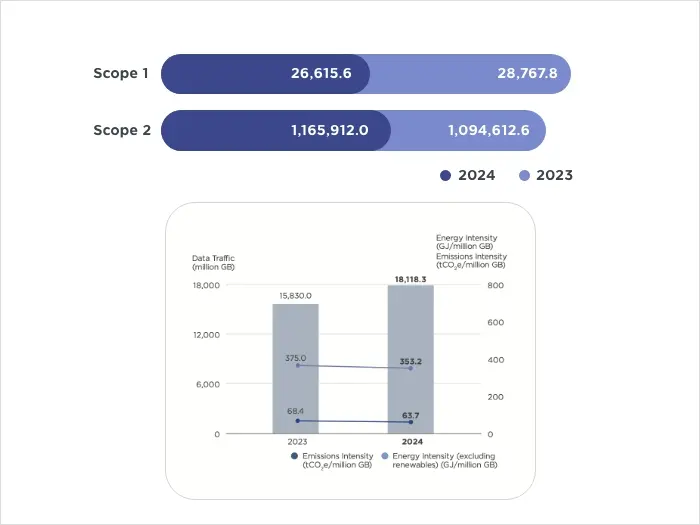
In 2024, our Scope 1 emissions reduced by 7%. Meanwhile, our Scope 2 emissions increased by 7% due to business growth, mainly attributed to the rise in the number of sites, additional equipment and efforts to enhance network quality and efficiency.
Transform our value chain
Our goal to reduce our carbon footprint goes beyond our operations and cuts across our value chain.
Scope 3 emissions are emissions that are outside the direct control of a company and occur across its value chain. They can typically make up more than two-thirds of a telco’s total carbon emissions footprint and sometimes more than 90%, and thus constitute a key area of focus.
In June 2024, our Scope 3 emissions baseline and net-zero target were formally approved by the Science Based Targets initiative (SBTi). This milestone lays a strong foundation for deeper engagement and collaboration with our suppliers to embed emissions reduction practices that support long-term, sustainable progress.
Initiatives to transform value chain
Recognised the sustainability efforts of their partners through the XL Axiata ESG Warrior Awards, thereby encouraging ESG initiatives across the value chain
(XL Axiata is known as XLSMART since 16 April 2025)
Audited selected vendors, representing 11% of total spend in 2023, with a waste evaluation tool integrated into these audits to enhance carbon performance and raise operational awareness
Engaged top suppliers to raise awareness of environmental challenges, drive best practices, and encourage collaborative efforts in emissions reduction
Launched the Vendor Development Programme (VDP) 2024 while conducting supplier ESG assessments and hosting the inaugural ESG Telecommunication & Technology Roundtable, which focused on the challenges of decarbonisation
Deliver an inclusive climate agenda
While the digital sector is responsible for only small percentage of global emissions, its technology has the potential to unleash a transformative effect on climate action efforts worldwide and could directly enable a third of the global emissions reductions needed by 2030.
With this in mind, our target is to contribute to positive climate action via carbon removal and enable avoidance through the targeted use of technology and digitalisation.
Initiatives to deliver an inclusive climate agenda

Launched a tech-driven conservation platform to track carbon absorption, tree growth and biodiversity impact, with B2B and B2C models developed to drive effective conservation efforts

Implemented infrastructural improvements – including the installation of advanced cooling systems and in-row cooling – while relocating equipment from data centre to containment areas to optimise energy and lower operational costs

Converted 23 sites from off-grid to grid connections, ensuring a reliable power supply, reducing diesel consumption, and lowering operational costs.
Converted 11 genset sites to Solar Hybrid Sites to reduce fuel consumption and emissions while deploying DC Energy Leasing solutions as a cost-effective power option in energy-critical markets.
Adopting the TFCD recommendations
We adopted the Task Force on Climate-related Financial Disclosures (TCFD) recommendations and launched a three-year TCFD roadmap in 2022. Since then, we have progressively enhanced our data quality, methodologies, and climate-related practices. These efforts have enabled us to better integrate climate risks and opportunities into our operations and strategic planning — strengthening our disclosures and building greater stakeholder trust. A high-level overview of our TCFD disclosures is provided below. For detailed insights into our approach across the four TCFD pillars and our 2024 progress, please download our Integrated Annual Report 2024.




Climate-Related Roles & Responsibilities
The Board retains ultimate responsibility for our Group’s sustainability agenda, with the Board Sustainability Committee (BSC) providing oversight on climate-related matters and ensuring the integration of ESG considerations into our corporate strategy. This is reinforced through regular updates, including periodic BSC sessions and quarterly meetings of the Sustainability Steering Committee.
At the management level, the Group CEO and Senior Leadership Teams are accountable for sustainability-related KPIs, including climate action targets aligned with our net-zero commitment. These sustainability KPIs are embedded in performance evaluations and linked to remuneration.
The Axiata Sustainability Steering Committee, chaired by the Group CEO & Managing Director, drives ESG alignment and collaboration across the Group. At the operational level, OpCo CEOs and Boards are responsible for embedding sustainability into their decision-making and governance processes.

The Board retains ultimate responsibility for our Group’s sustainability agenda, with the Board Sustainability Committee (BSC) providing oversight on climate-related matters and ensuring the integration of ESG considerations into our corporate strategy. This is reinforced through regular updates, including periodic BSC sessions and quarterly meetings of the Sustainability Steering Committee.
At the management level, the Group CEO and Senior Leadership Teams are accountable for sustainability-related KPIs, including climate action targets aligned with our net-zero commitment. These sustainability KPIs are embedded in performance evaluations and linked to remuneration.
The Axiata Sustainability Steering Committee, chaired by the Group CEO & Managing Director, drives ESG alignment and collaboration across the Group. At the operational level, OpCo CEOs and Boards are responsible for embedding sustainability into their decision-making and governance processes.
Identifying Climate-Related Risks and Opportunities
We continuously assess climate-related risks and opportunities to proactively address emerging challenges and position our business for long-term success in a low-carbon economy.
These risks and opportunities are integrated into our Enterprise Risk Management (ERM) Framework, embedding climate considerations into our strategic planning and enhancing organisational resilience. This is supported by ongoing climate risk assessments using established tools and models to better anticipate potential impacts and enable informed, forward-looking decisions.
Looking ahead, we aim to further embed climate-related risks into our planning and decision-making processes, in line with the evolving disclosure requirements of IFRS S1 and S2, which will take effect from 2025.

Climate Change
We recognise the importance of taking committed, long-term climate action, not only in response to climate science and increasing escalating physical risks, but also as a catalyst for operational resilience, innovation and efficiency.
As part of our commitment to achieving net-zero emissions by 2050, we are currently updating our Net-Zero Carbon Roadmap with clearly defined near-term and net-zero targets based on a 2022 baseline. These targets include reducing absolute Scope 1 and Scope 2 greenhouse gas (GHG) emissions by 42% by 2030 and 90% by 2050, as well as reducing absolute Scope 3 emissions by 25% by 2030 and 90% by 2050.
In June 2024, these targets were approved by the Science Based Targets initiative (SBTi), making Axiata the first telecommunications company in Malaysia to receive such validation. This endorsement affirms that our decarbonisation pathway is grounded in climate science and aligned with internationally recognised best practices.
Our approach to climate action is further strengthened by our adoption of the Task Force on Climate-related Financial Disclosures (TCFD) recommendations, which strengthen our ability to assess climate-related risks and embed them into strategic decision-making.
Our pathway to net-zero
The Axiata Net-Zero Carbon Roadmap outlines three strategic objectives that chart our course towards achieving net-zero carbon emissions by no later than 2050.
The roadmap is currently undergoing an update and will be made available for download once this process is completed
Decarbonise network operations
Near-term target to reduce absolute Scope 1 and Scope 2 GHG emissions by 42% by 2030 from a 2022 baseline*
*Reduction targets set in accordance with SBTi guidelines
Transform our value chain
Long-term target to reduce absolute Scope 3 GHG emissions by 25% by 2030 from a 2022 baseline*
*Reduction targets set in accordance with SBTi guidelines
Deliver an inclusive climate agenda
Contribute to positive climate action through carbon removal and by enabling avoidance through technology and digitisation
Decarbonise network operations
The first objective of our Net-Zero Carbon Roadmap is about reducing emissions from our operations (Scope 1 and 2). Our approach centres on strengthening energy efficiency and identifying opportunities for the introduction of renewable energy sources. We also engage in dialogue with industry players, government authorities and communities, where we advocate for climate policies and investments that would help us reach our goals and achieve national climate ambitions.
Initiatives to decarbonise network operations
We continue to achieve progress in developing a strategic roadmap for reducing our Scope 1 and 2 emissions. Our focus areas include enhancing energy efficiency across network infrastructure, scaling on-site renewable energy generation, and actively evaluating Renewable Energy Certificate (REC) and Power Purchase Agreement (PPA) options in high-emission markets across our OpCos.
Our OpCos made the following progress in 2024:
Co-hosted the Axiata Sustainability & Reporting Suite Forum in Jakarta to align with net-zero and TCFD action plans, strengthen Sustainability Framework implementation, and standardise reporting
(XL Axiata is known as XLSMART since 16 April 2025)
Subscribed to Tenaga Nasional Berhad’s Green Electricity Tariff (GET) Programme for selected sites in Malaysia
We achieved an approximate 11% reduction in network fuel energy consumption and 29% reduction in facility electricity energy consumption in 2024, marking strong progress in a key pillar of our net-zero efforts.
Highlights of our OpCos’ performance included:
Implemented features saving, simplification, and fuel reduction measures at network sites, saving approximately 93 million kWh of electricity and 112 litres of fuel
(XL Axiata is known as XLSMART since 16 April 2025)
Implemented a range of measures including minimising diesel-powered genset dependency, implementing containment for cooling optimisation and upgrading rectifiers across sites
Implemented DC Energy Leasing and Remote Monitoring System (RMS) to optimise network energy consumption, improve energy efficiency and enable proactive maintenance
Converted 603 indoor base station sites to outdoor setups, while reducing energy consumption through network modernisation and legacy system shutdowns
Implemented iPowerStar 2.0 – an AI-powered solution – across the Smart network, while introducing Intelligent Digital Management Unit (iDMU) to dynamically manage network capacity by shutting down low-traffic cells
Upgraded Hybrid Fibre-Coaxial (HFC) home-passed areas to Fibre to the Home (FTTH), improving energy efficiency and network performance
As of end-2024, we have deployed over 7,178 solar sites across our operations to help mitigate the carbon-intensive energy mix in our markets. In parallel, our OpCos continue to phase out diesel generators by introducing lithium battery systems and hybrid charging solutions for remote Base Transceiver Stations (BTS), significantly reducing diesel consumption.
OpCo highlights in 2024 include:
Deployed solar panels, including four new Supernode Solar Panels situated in key locations, and purchased 1,000 RECs
(XL Axiata is known as XLSMART since 16 April 2025)
Implemented solar energy solutions at new and existing access sites, adding nearly 50 kW of solar capacity during the year
Deployed 150 new solar sites in 2024, bringing its total to 1,674 sites across Cambodia
Converted genset sites to solar hybrid sites, integrating solar PV panels with diesel generators to ensure reliable power for off-grid locations
Our Energy Consumption Performance
Group-wide energy consumption (excluding energy generated from renewables) increased by approximately 7% in 2024. Close to 92% of energy consumed across the operations during the year was used to power the network.
Our Carbon Emissions Performance
In 2024, our Scope 1 emissions reduced by 7%. Meanwhile, our Scope 2 emissions increased by 7% due to business growth, mainly attributed to the rise in the number of sites, additional equipment and efforts to enhance network quality and efficiency.
Transform our value chain
Our goal to reduce our carbon footprint goes beyond our operations and cuts across our value chain.
Scope 3 emissions are emissions that are outside the direct control of a company and occur across its value chain. They can typically make up more than two-thirds of a telco’s total carbon emissions footprint and sometimes more than 90%, and thus constitute a key area of focus.
In June 2024, our Scope 3 emissions baseline and net-zero target were formally approved by the Science Based Targets initiative (SBTi). This milestone lays a strong foundation for deeper engagement and collaboration with our suppliers to embed emissions reduction practices that support long-term, sustainable progress.
Initiatives to transform value chain
Recognised the sustainability efforts of their partners through the XL Axiata ESG Warrior Awards, thereby encouraging ESG initiatives across the value chain
(XL Axiata is known as XLSMART since 16 April 2025)
Audited selected vendors, representing 11% of total spend in 2023, with a waste evaluation tool integrated into these audits to enhance carbon performance and raise operational awareness
Engaged top suppliers to raise awareness of environmental challenges, drive best practices, and encourage collaborative efforts in emissions reduction
Launched the Vendor Development Programme (VDP) 2024 while conducting supplier ESG assessments and hosting the inaugural ESG Telecommunication & Technology Roundtable, which focused on the challenges of decarbonisation
Deliver an inclusive climate agenda
While the digital sector is responsible for only small percentage of global emissions, its technology has the potential to unleash a transformative effect on climate action efforts worldwide and could directly enable a third of the global emissions reductions needed by 2030.
With this in mind, our target is to contribute to positive climate action via carbon removal and enable avoidance through the targeted use of technology and digitalisation.
Initiatives to deliver an inclusive climate agenda
Launched a tech-driven conservation platform to track carbon absorption, tree growth and biodiversity impact, with B2B and B2C models developed to drive effective conservation efforts
Implemented infrastructural improvements – including the installation of advanced cooling systems and in-row cooling – while relocating equipment from data centre to containment areas to optimise energy and lower operational costs
Converted 23 sites from off-grid to grid connections, ensuring a reliable power supply, reducing diesel consumption, and lowering operational costs.
Converted 11 genset sites to Solar Hybrid Sites to reduce fuel consumption and emissions while deploying DC Energy Leasing solutions as a cost-effective power option in energy-critical markets.
Adopting the TFCD recommendations
We adopted the Task Force on Climate-related Financial Disclosures (TCFD) recommendations and launched a three-year TCFD roadmap in 2022. Since then, we have progressively enhanced our data quality, methodologies, and climate-related practices. These efforts have enabled us to better integrate climate risks and opportunities into our operations and strategic planning — strengthening our disclosures and building greater stakeholder trust. A high-level overview of our TCFD disclosures is provided below. For detailed insights into our approach across the four TCFD pillars and our 2024 progress, please download our Integrated Annual Report 2024.
Climate-Related Roles & Responsibilities
The Board retains ultimate responsibility for our Group’s sustainability agenda, with the Board Sustainability Committee (BSC) providing oversight on climate-related matters and ensuring the integration of ESG considerations into our corporate strategy. This is reinforced through regular updates, including periodic BSC sessions and quarterly meetings of the Sustainability Steering Committee.
At the management level, the Group CEO and Senior Leadership Teams are accountable for sustainability-related KPIs, including climate action targets aligned with our net-zero commitment. These sustainability KPIs are embedded in performance evaluations and linked to remuneration.
The Axiata Sustainability Steering Committee, chaired by the Group CEO & Managing Director, drives ESG alignment and collaboration across the Group. At the operational level, OpCo CEOs and Boards are responsible for embedding sustainability into their decision-making and governance processes.
The Board retains ultimate responsibility for our Group’s sustainability agenda, with the Board Sustainability Committee (BSC) providing oversight on climate-related matters and ensuring the integration of ESG considerations into our corporate strategy. This is reinforced through regular updates, including periodic BSC sessions and quarterly meetings of the Sustainability Steering Committee.
At the management level, the Group CEO and Senior Leadership Teams are accountable for sustainability-related KPIs, including climate action targets aligned with our net-zero commitment. These sustainability KPIs are embedded in performance evaluations and linked to remuneration.
The Axiata Sustainability Steering Committee, chaired by the Group CEO & Managing Director, drives ESG alignment and collaboration across the Group. At the operational level, OpCo CEOs and Boards are responsible for embedding sustainability into their decision-making and governance processes.
Identifying Climate-Related Risks and Opportunities
We continuously assess climate-related risks and opportunities to proactively address emerging challenges and position our business for long-term success in a low-carbon economy.
These risks and opportunities are integrated into our Enterprise Risk Management (ERM) Framework, embedding climate considerations into our strategic planning and enhancing organisational resilience. This is supported by ongoing climate risk assessments using established tools and models to better anticipate potential impacts and enable informed, forward-looking decisions.
Looking ahead, we aim to further embed climate-related risks into our planning and decision-making processes, in line with the evolving disclosure requirements of IFRS S1 and S2, which will take effect from 2025.